


🎧 Listen to article read by Nicoletta:
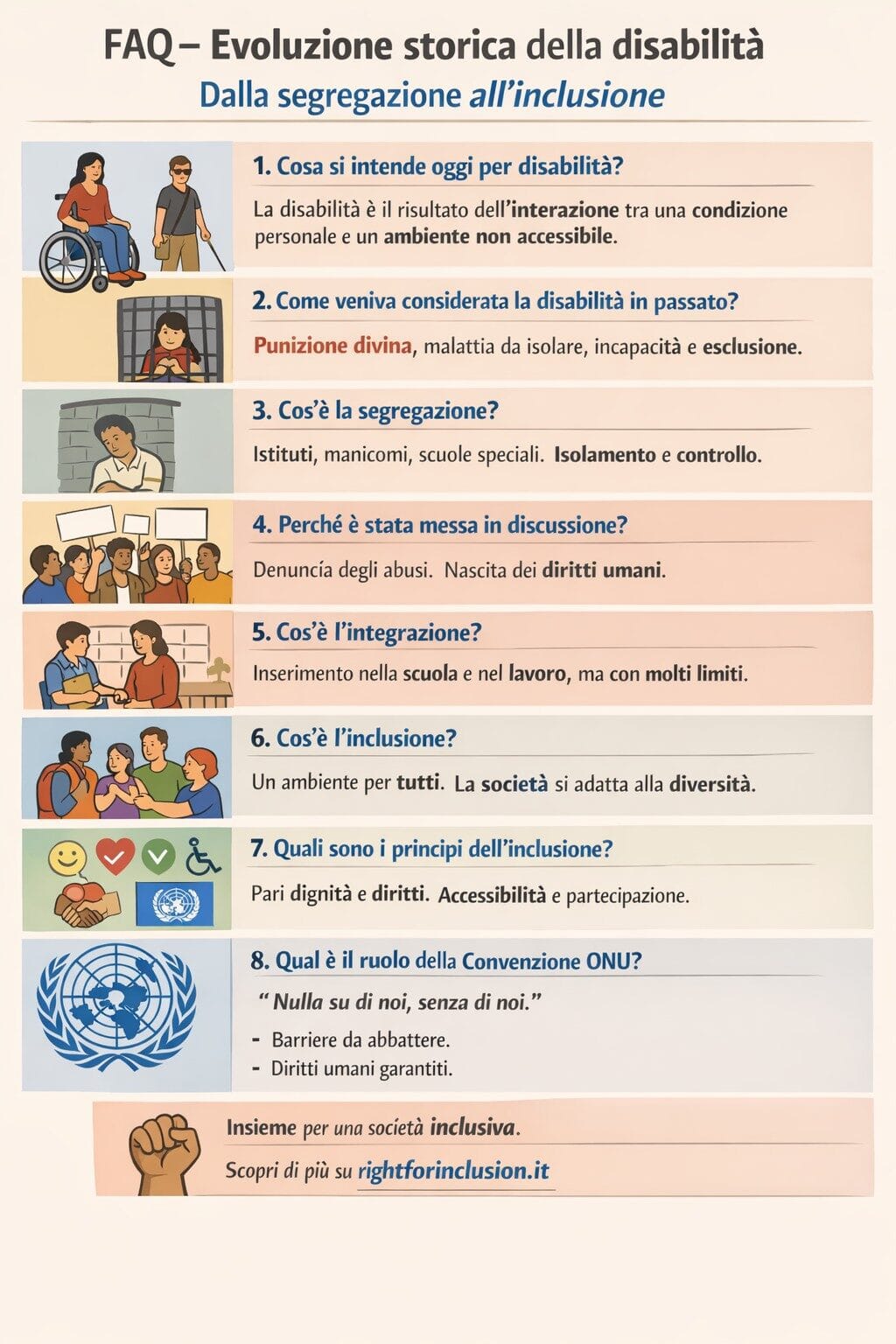
1. What is meant today for disability?
Today disability it is recognized as the result of the interaction between a personal condition (physical, sensory, intellectual or mental), and a environment that is not designed to accommodate all the people.
It is therefore not only a matter individual, but social, cultural and policy.
This approach is based on the social model and human rights, stated at the international level.
2. As it was considered a disability in the past?
For centuries the disability was:
- interpreted as divine punishment, guilt or disgrace;
- view as disease to treat or anomaly from isolate;
- associated with inability and dependency.
These visions have justified thesocial exclusion and the denial of rights.
3. What is segregation?
The segregation it is the first and longest historical model.
Main features:
- Physical separation and social of people with disabilities.
- Insertion in institutions, hospitals, asylums, schools for special education.
- No chance or self-determination.
- The prevalence of the logic of control and assistance.
Effects:
- Insulation from the community.
- Loss of social identity.
- Violations of human rights.
- The person with a disability was seen as a problem to go away.
4. Because the segregation was challenged?
Starting from the Twentieth century:
- emerging studies that expose the conditions of the institutes.
- we affirm the universal human rights;
- the same people with disabilities begin to claim in dignity and rights.
- This leads to a slow overcoming segregation.
5. What is integration?
L’integration born as a response to the segregationespecially between the years ’60 and ’90.
What introduces:
- Insertion of persons with disabilities in the scuola, in work and in society.
- Specific media: support teachers, assistance, and services.
- Greater visibility and social recognition.
Limits:
- The context remains thought to the “normality”.
- The person must adapt to the system.
- The diversity is accepted only if not disturbing.
L’integration is a step forward, but it does not delete the inequality.
6. What is the path to Italian?
Italy has been pioneer in some areas, especially in the school:
- Law 517/1977 – the abolition of classes and the insertion in the common school.
- Law 104/1992 – law framework for the protection rights, social integration, and school.
Despite the plant-advanced, there remain difficulties to be applied and inequalities territorial.
7. What is inclusion?
The inclusion represents a paradigm shift.
It means that:
- It is not the person to adapt.
- Is the company that should be rethought and transformed.
- The diversity it is a natural part of the human community.
Areas involved:
- school
- work
- public spaces
- services
- participation in the political and cultural
8. What are the principles of inclusion?
- Equal dignity
- Equal rights
- Autonomy
- Universal accessibility
- Active participation
- Self-determination
The inclusion applies to all people, not only those who have a disabilities.
9. What is the role of the UN Convention (2006)?
The The UN convention on the rights of persons with disabilities marks a historic turning point.
States that:
- people with disabilities are subjects of rights, not the beneficiaries of assistance;
- States must remove the barriers;
- l’theeducation must be inclusive;
- independent living is a right.
Guiding principle:
“Nothing about us, without us.”
10. Inclusion means only physical accessibility?
No
- language and communication;
- cultural attitudes;
- prejudices and stereotypes;
- real opportunities for work and study.
Linclusion also covers:
Without a cultural change, l’inclusion it remains the only formal.
11. The inclusion is already fully implemented?
No.
Persist:
- barriers architectural and digital;
- discrimination in the labour market;
- servicesnsufficienti;
- patchy enforcement of the laws.
L’inclusion is a continuous process, not a goal already achieved.
12. Because this evolution concerns the whole of society?
Because a inclusive society:
- more right;
- more democratic;
- improves quality of life of all.
The rights of persons with disabilities are human rights.
Call to Action:
Inclusion is not a concession,
it is a fundamental right.
Together, we can turn rights into reality.
Find out about the rightforinclusion.en and write to info@rightforinclusion.it