


🎧 Listen to article read by Nicoletta:
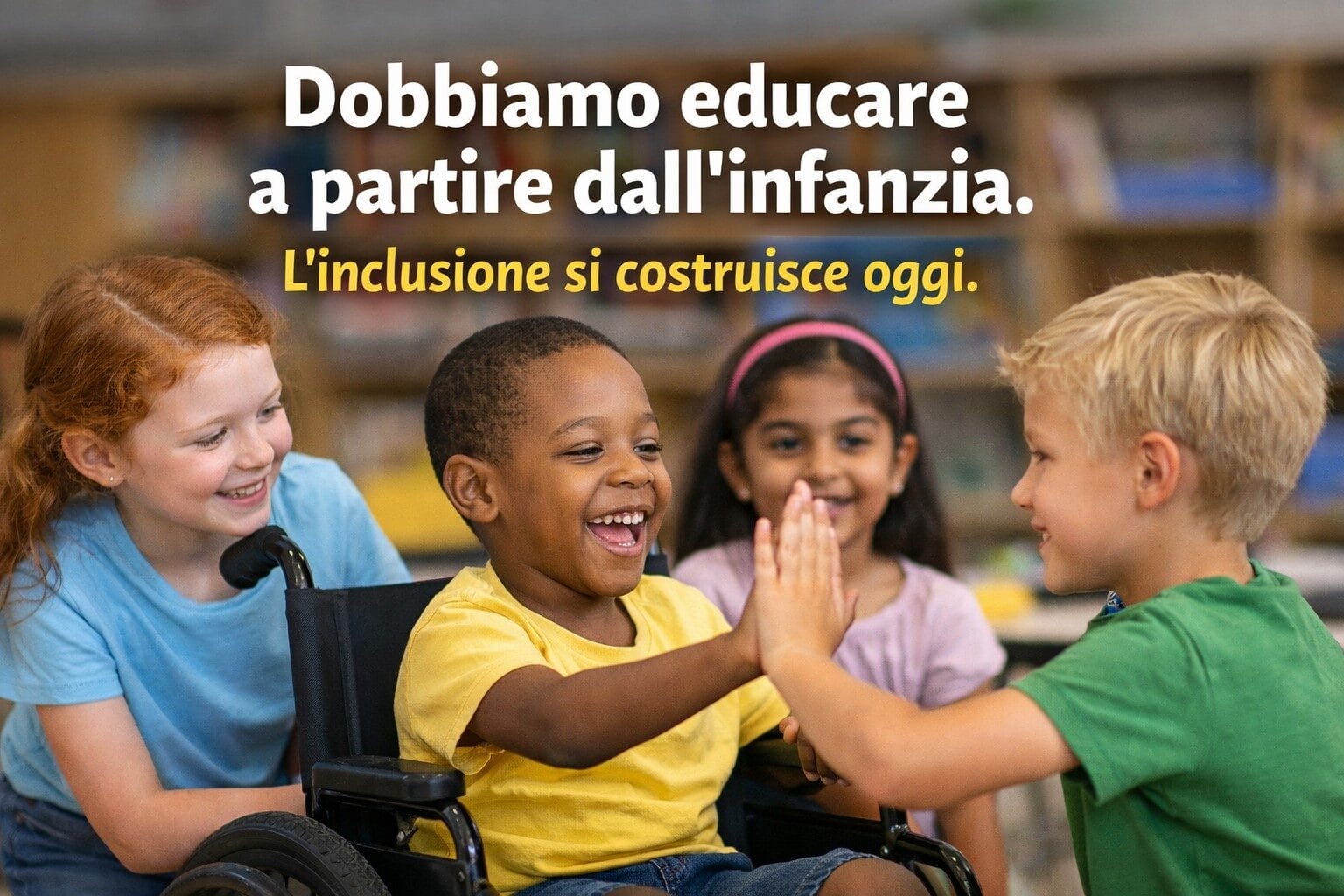
We have educate starting from childhood.
It is not a sentence rhetoric, nor an abstract principle: it is a the concrete responsibilities and collectivenot to procrastinate.
The diversity continues to be perceived as something “other”, in the distance, sometimes, even the uncomfortable.
Almost like a problema to explain or manage.
But this perception does not have to be the case: it builds over time, through the silences, no explanations, and missed opportunities to educate at a glance and to the awareness.
And then the question is inevitable:
“If we are not starting from childhood, when we think we really start?“
- Diversity is not a’exception, is the rule
- Diversity is not a error to be correct nor deviationand from the norm.
- It is part of the reality of everyday life, of human relations.
Yet, often, we treat it as something extraordinaryto face only when “the problem”.
So raise children who learn to distinguish between what is considered “normal” and what is perceived as the differentwithout the tools to to understand, embrace and respect.
Educating for diversity means teach us to look at the other as a person, before that as a label.
Means build awareness that allows you to go beyond theappearance and prejudices.
To educate is not to explain: it is to create contexts
L’education for diversity it can not be reduced to a lesson occasional or symbolic day.
Must pass through the places of growth, and be part of the structure:
- schools
- sport centres
- cultural places
- spaces of social aggregation
These are the contexts in which they learn to be together, to relate, to recognize the other as equal.
And it is here that you build – or deny – a culture of inclusion.
“If these places do not educate to diversity, what's the message we are sending to the new generations?”
Inclusion: a skill that builds
Inclusion is not a slogan nor a concession.
Is a jurisdiction that is learned over time, through experiences, languages, and daily practices.
Later we begin to educate the diversity, the more it becomes difficult to remove stereotypes, fears, and barriers.
As soon as we do this, the more it will be natural to live in a a company that recognizes the rights without having to continually claim.
And then the question is not whether to speak or not diversity.
The real question is:
“What kind of society we want to build, if we continue to postpone the education inclusion?“
Call to action
- We're really educating for diversity or continue to delegate and delay?
- Adults become children of today, if you do not learn now the value of inclusion?
On rightforinclusion.en find thoughts, stories and insights speaking of rights, disability and inclusion, without rhetoric, and without filters.
Do you want to have your say? Participates in the comparison.
Write in the section Join of rightforinclusion.en
or send your contribution to to info@rightforinclusion.it.
Because inclusion is not born from silence, but from the shared awareness.